
CHRISTMAs NATIVITY
What's with the Nativity?
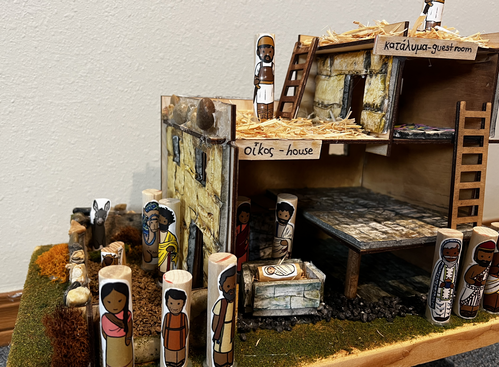
You might be wondering why this little wooden diorama is being used as our nativity. After all, wasn’t Jesus born in a cave or a stable since there was “no room in the inn?” Well, perhaps, but we think a closer reading of scripture and a better understanding of 1st century home construction in Judea gives us a better idea of the conditions Jesus was born in.
Luke 2
In reading through Luke’s account of Jesus birth—something that was very likely passed on to him by Mary—there are a few things that help us to better understand what’s taking place. When the call went out from Quirinius for everyone to return to their ancestral home (Luke 2:2) for the census, Joseph, along with his pregnant soon-to-be-wife Mary, traveled to Bethlehem (Luke 2:4). Since this was his ancestral home, undoubtedly, he would have found relatives living there, especially considering Bethlehem was the home of King David—someone whom Joseph was related to. When traveling to one’s ancestral home, call-ahead reservations didn’t need to be made since a family member would have been welcomed with open arms not only by immediate family but by town residents as well. Invites to stay in someone’s home-especially when with-child, would have been plenty, and to refuse to assist Mary and Joseph in their condition would have been a cultural no-no!
In Luke 2:6, we read that “while [Mary and Joseph] were there” it came time for Jesus to be born. This phrase tells us that they had already been in Bethlehem for a time. How long? We don’t know but considering they had to travel, possibly on foot, the 80-90 miles from Nazareth to Bethlehem, being the good fiancé Joseph was, we should assume he did not wait until Mary’s last week of pregnancy to do this.
When it comes time for the birth of Jesus to take place, we read that Jesus was “wrapped in cloths and placed in a manger.” At first glance, reading this verse, especially in English, causes us to think that they were in a stable or barn because that’s where you would find a manger today. However, we know through extensive research and archeology that most mangers, especially in a town like Bethlehem, would have been found inside the home on the ground floor. Why? Because at night, livestock such as goats and sheep would have been brought inside the house for protection from robbers and predators. It was so common for livestock to be kept indoors that in the Old Testament, even Jephthah made a promise to God because of what he believed would come outside upon his return from battle (Judges 11).
Now, what about the inn?
Well, again, a modern English reading of Luke 2 makes things a little confusing. However, when we read the Greek (the language that Luke was written in) we see that the word used for inn is the Greek word katalyma. The word katalyma means guest room, which in a 1st century Judean home, would have been typically located on the topmost floor of a home. This word is also used to describe the room where Jesus and his disciples ate their last Passover meal (Luke 22:11). The word used to describe something like an inn or what we would recognize as a hotel in Greek is pandokeion, which is the place where the Good Samaritan brought the injured man he found on the road in Luke 10:25-37, and that’s not the word that Luke uses in the nativity story. Why was there no room in the katalyma? Because the house was full of people who had also traveled to Bethlehem for the census.
Taking all of this together, in addition to Matthews gospel (Matthew 2:11) telling us that the wise men arrived at a house, and not a stable or cave, and that the shepherds in the fields of Bethlehem took no issue with the conditions they found Jesus in (Luke 2:12), as well as what we know of Middle Eastern hospitality, we should surmise that Jesus was not born in a stable or cave and that Mary and Joseph were not all on their own for the event. Rather, it is much more likely that they were surrounded by family in a loving—but over-flowingly full—home that was alight with joy and celebration at the birth of this baby boy.
We hope you enjoy our little nativity and experiencing Christmas in a new way!!
Luke 2
In reading through Luke’s account of Jesus birth—something that was very likely passed on to him by Mary—there are a few things that help us to better understand what’s taking place. When the call went out from Quirinius for everyone to return to their ancestral home (Luke 2:2) for the census, Joseph, along with his pregnant soon-to-be-wife Mary, traveled to Bethlehem (Luke 2:4). Since this was his ancestral home, undoubtedly, he would have found relatives living there, especially considering Bethlehem was the home of King David—someone whom Joseph was related to. When traveling to one’s ancestral home, call-ahead reservations didn’t need to be made since a family member would have been welcomed with open arms not only by immediate family but by town residents as well. Invites to stay in someone’s home-especially when with-child, would have been plenty, and to refuse to assist Mary and Joseph in their condition would have been a cultural no-no!
In Luke 2:6, we read that “while [Mary and Joseph] were there” it came time for Jesus to be born. This phrase tells us that they had already been in Bethlehem for a time. How long? We don’t know but considering they had to travel, possibly on foot, the 80-90 miles from Nazareth to Bethlehem, being the good fiancé Joseph was, we should assume he did not wait until Mary’s last week of pregnancy to do this.
When it comes time for the birth of Jesus to take place, we read that Jesus was “wrapped in cloths and placed in a manger.” At first glance, reading this verse, especially in English, causes us to think that they were in a stable or barn because that’s where you would find a manger today. However, we know through extensive research and archeology that most mangers, especially in a town like Bethlehem, would have been found inside the home on the ground floor. Why? Because at night, livestock such as goats and sheep would have been brought inside the house for protection from robbers and predators. It was so common for livestock to be kept indoors that in the Old Testament, even Jephthah made a promise to God because of what he believed would come outside upon his return from battle (Judges 11).
Now, what about the inn?
Well, again, a modern English reading of Luke 2 makes things a little confusing. However, when we read the Greek (the language that Luke was written in) we see that the word used for inn is the Greek word katalyma. The word katalyma means guest room, which in a 1st century Judean home, would have been typically located on the topmost floor of a home. This word is also used to describe the room where Jesus and his disciples ate their last Passover meal (Luke 22:11). The word used to describe something like an inn or what we would recognize as a hotel in Greek is pandokeion, which is the place where the Good Samaritan brought the injured man he found on the road in Luke 10:25-37, and that’s not the word that Luke uses in the nativity story. Why was there no room in the katalyma? Because the house was full of people who had also traveled to Bethlehem for the census.
Taking all of this together, in addition to Matthews gospel (Matthew 2:11) telling us that the wise men arrived at a house, and not a stable or cave, and that the shepherds in the fields of Bethlehem took no issue with the conditions they found Jesus in (Luke 2:12), as well as what we know of Middle Eastern hospitality, we should surmise that Jesus was not born in a stable or cave and that Mary and Joseph were not all on their own for the event. Rather, it is much more likely that they were surrounded by family in a loving—but over-flowingly full—home that was alight with joy and celebration at the birth of this baby boy.
We hope you enjoy our little nativity and experiencing Christmas in a new way!!